

Autonomous agents are quickly becoming the most talked-about shift in enterprise technology — and for good reason. Unlike traditional software that simply answers a single request, autonomous agents can plan, decide, and act on their own to complete a goal from start to finish. If you’ve heard the term everywhere lately but aren’t sure what it actually means, this guide breaks down autonomous agents in plain language: how they work, why they’re exploding in 2026, and what they mean for businesses and everyday users.
Table of Contents
What Are Autonomous Agents?
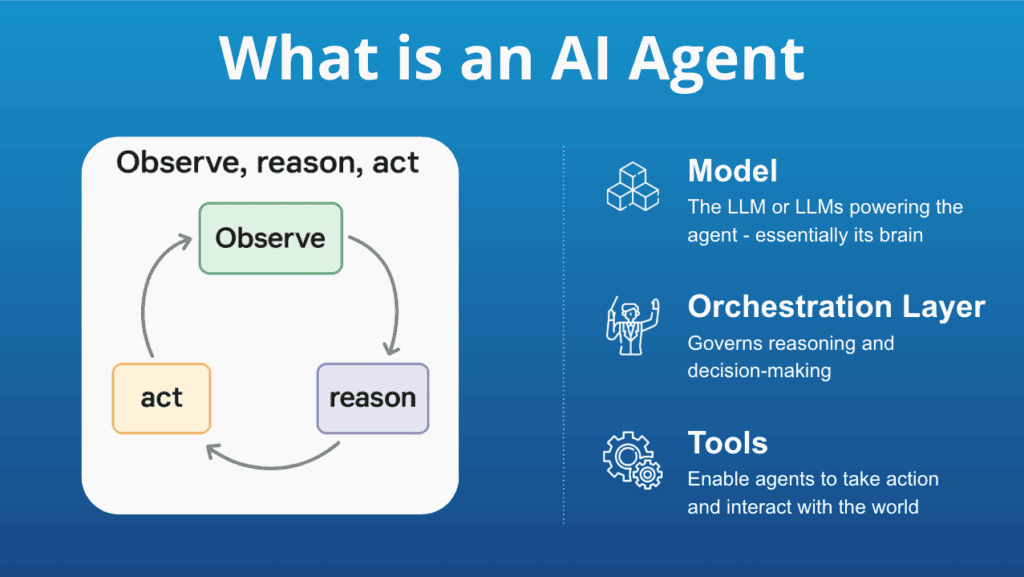
Autonomous agents are software systems that act independently toward a defined goal, rather than simply responding to a single instruction. Instead of a one-off request-and-response exchange, an autonomous agent breaks a goal into steps, chooses the tools or actions needed, executes them, evaluates the outcome, and adjusts — often with minimal human oversight.
This category is sometimes referred to as “agentic AI” or “AI agents” in industry coverage, but the core idea is the same: independent, goal-driven action rather than a single reactive response.
Suggested image: A simple flow diagram showing “Goal → Plan → Act → Evaluate → Adjust.” Alt text: “Autonomous agents workflow diagram showing how goal-driven systems plan and execute tasks.”
How do these work?
Every system of this kind is built around five core capabilities. Understanding these makes it much easier to spot genuine autonomous agents versus a tool that’s simply labeled that way for marketing purposes.
1. Independence
Autonomous agents decide their own next step within defined boundaries, rather than waiting for a human to approve each action.
2. Planning
Autonomous agents break a broad goal into an ordered sequence of smaller tasks, similar to how a human project manager would map out a workflow.
3. Tool Use
Autonomous agents connect to external tools — APIs, browsers, databases, or software applications — to actually carry out tasks, not just describe them.
4. Memory
Autonomous agents retain context across multiple steps (and sometimes across sessions), allowing them to track progress toward a longer-term goal.
5. Feedback Loops
Autonomous agents check their own output against the intended goal and self-correct when something doesn’t work, rather than stopping at the first error.
Autonomous Agents vs. Traditional Automation
This is one of the most common points of confusion, so here’s a direct comparison:
| Feature | Traditional Automation | Autonomous Agents |
|---|---|---|
| Primary function | Follows a fixed, pre-written script | Plans and completes multi-step goals |
| Interaction style | Reactive — one trigger, one action | Proactive—plans and adapts across steps |
| Tool access | Limited to pre-configured integrations | Actively selects and uses external tools |
| Memory | Typically none between runs | Persists across steps or sessions |
| Human involvement | Defines every rule in advance | Sets the goal; may only review the result |
In short: traditional automation follows instructions, while autonomous agents figure out how to reach an outcome. Many real-world systems in 2026 combine both—using rule-based automation for predictable steps and autonomous agents for the parts that require judgment.
Real-World Examples
Autonomous agents are already running inside major business functions:

- Customer service — resolving refunds, rebookings, and account changes end-to-end instead of just answering FAQs
- Software development — writing code, testing it, fixing bugs, and opening pull requests with minimal supervision
- Cybersecurity — continuously monitoring networks, detecting anomalies, and initiating automated responses to threats in real time
- Sales and marketing — qualifying leads, personalizing outreach, and managing campaigns independently
- IT operations — detecting system issues and resolving them before they escalate
- Finance — reconciling transactions, flagging anomalies, and generating reports without manual review at every step
Market Size and Growth in 2026
The numbers explain why autonomous agents are dominating tech conversations this year. Estimates vary by research firm depending on definitional scope, but the overall trend is consistent:
- The global market for this technology is valued at roughly $9–11 billion in 2026, with most analysts projecting a compound annual growth rate above 40% per year through the early 2030s
- Gartner projects that 40% of enterprise applications will include task-specific autonomous agents by the end of 2026—up from under 5% in 2025
- Despite the hype, only around 23% of organizations report having scaled a system like this into full production, while many others remain in the experimentation phase
- Gartner also forecasts that more than 40% of these projects will be scrapped by 2027, largely due to unclear business value, rising costs, and weak risk controls
- A large majority of organizations already use some form of autonomous agent, but far fewer have formal security policies governing how they’re allowed to operate—a gap worth watching closely if you’re also thinking about AI-powered cybersecurity (internal link placeholder—link to your related cybersecurity article here)
In other words, adoption is real, but the gap between piloting these systems and running them reliably in production is still wide.
Benefits
- Speed — completes multi-step workflows in a fraction of the time a human team would need
- Consistency — performs repetitive processes the same way every time, reducing human error
- Scalability — handles a growing volume of tasks without proportionally growing headcount
- 24/7 availability — operates continuously without fatigue
- Cost efficiency — early adopters report meaningful reductions in operational costs from automating multi-step processes
Risks and Challenges
Independence is the biggest strength of them—and their biggest risk. A system that can act, not just respond, can also make costly mistakes at machine speed.
- Unintended actions—a notable share of companies report instances of agents accessing unauthorized systems or sharing data without permission
- Security policy gaps — many organizations deploy autonomous agents faster than they build governance frameworks to control them
- Unclear ROI—a large portion of early projects stall or get cancelled due to unclear business value
- Over-trust—treating agent output as final without human review can compound small errors into larger ones
- Integration complexity—connecting autonomous agents to legacy systems and existing software stacks is often harder than expected
This is why most successful deployments in 2026 still include “human-in-the-loop” checkpoints for higher-stakes decisions, rather than granting fully unsupervised independence.
How to Prepare Your Business
- Start with a narrow, well-defined use case rather than a broad, open-ended goal
- Set clear permission boundaries for what the agent can and cannot do without approval
- Build monitoring and logging into every workflow from day one
- Create a governance policy before scaling — not after an incident forces one
- Measure business outcomes, not just automation activity, to track real ROI
- Keep a human checkpoint on any action involving money, sensitive data, or irreversible changes
The Future of Autonomous Agents
Analysts expect this technology to keep expanding well beyond 2026, with some forecasting that these systems could handle a meaningful share of routine business decisions within the next few years. The organizations that benefit most won’t be the ones that adopt autonomous agents fastest — they’ll be the ones that pair them with strong governance, clear goals, and thoughtful human oversight.
Frequently Asked Questions
Is this the same as general artificial intelligence? No. Autonomous agents are narrow and goal-specific — they operate within defined tasks and tools. General intelligence refers to a hypothetical system with broad, human-level reasoning across virtually any domain.
What’s the difference between “autonomous agents” and “agentic AI”? The terms are largely interchangeable in industry use. “Autonomous agents” describes the systems themselves, while “agentic AI” describes the broader technical approach behind how they’re built.
Are autonomous agents safe to use in business today? They can be, with the right safeguards—permission boundaries, monitoring, and human checkpoints for high-stakes actions. Deploying them without governance is where most real risk comes from.
Which industries are adopting autonomous agents the fastest? Customer service, software development, IT operations, cybersecurity, and finance are currently leading adoption, based on 2026 market data.
ChatGPT 4.0 App – Download Your Free AI Companion

ChatGPT App 4.0 – Your AI Companion Anytime, Anywhere Artificial intelligence has transformed the way we interact with technology, and one of the best examples of this innovation is the ChatGPT app by OpenAI. Designed as a personal AI chatbot, ChatGPT is more than just a digital assistant—it’s a companion that helps you find answers, spark ideas, and carry conversations that feel natural and intuitive. Available on mobile, the ChatGPT app ensures that intelligence is always in your pocket. Whether you need help drafting an email, solving a problem, or simply want to have a meaningful chat, the app is there to make life easier and smarter.
Key Takeaways
- Autonomous agents act independently toward a goal—planning, executing, and adjusting with minimal human input
- They differ from traditional automation by figuring out how, not just following a fixed script
- This market is growing over 40% annually in 2026, though production deployment still lags behind experimentation
- The biggest risks come from weak governance, not the technology itself
- Businesses that pair autonomous agents with clear guardrails will see the most reliable results
Tags
Autonomous Agents, Goal-Driven Systems, Enterprise Technology, Automation, Tech Trends 2026, Software Agents, Intelligent Systems, Future of Work, Governance, Digital Transformation
Hashtags
#AutonomousAgents #GoalDrivenTech #TechTrends2026 #Automation #EnterpriseTech #FutureOfWork #DigitalTransformation #SmartSystems #TechInnovation #SoftwareAgents