
Introduction
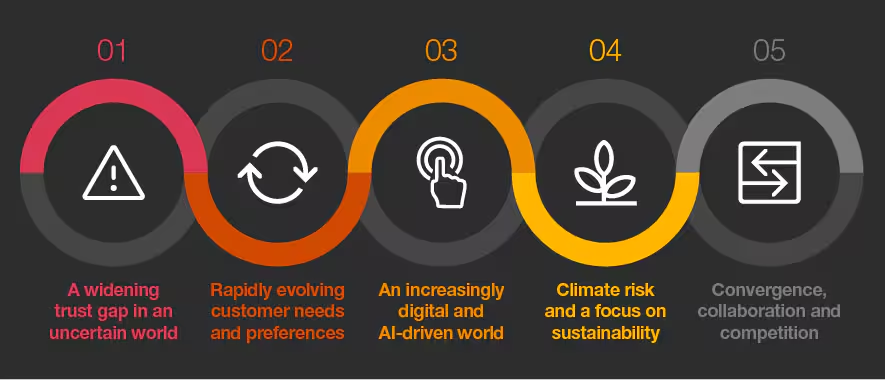
The insurance world is evolving rapidly. Between emerging risks, advanced technologies, and changing customer expectations, the traditional model is getting a serious makeover. Whether you’re a consumer trying to understand your policy or a professional working in the sector, these five trends are shaping the future of insurance.
Table of Contents
1. Cyber & Digital Risks Are Driving New Insurance Needs
As businesses and individuals become more connected, cyber-threats are no longer “nice to have” problems — they’re pressing matters. Ransomware attacks, data breaches, and identity thefts are forcing insurers to create tailored covers for cyber-security risks. StartUs Insights+2Zopper+2
What this means for you:
- Expect more insurers offering cyber-insurance policies — even for smaller businesses or individuals.
- Underwriting will become more rigorous: your behaviour and security posture might influence your premiums.
- Consumers need to evaluate not just the coverage, but the response readiness of insurers (incident response, etc.).
2. Embedded & Usage-Based Insurance (UBI) Are Rewriting How We Buy Coverage
Forget buying insurance just once a year. The new model is: insurance where you need it, when you need it. Examples: pay-as-you-drive car insurance, or coverage embedded into a purchase at the point of sale. WebFX+1
Implications:
- You might see more “micro-policies” — short-term, usage-based, flexible.
- Premiums may better reflect your actual behaviour, not just broad categories.
- This is good for consumers who behave responsibly — but if you’re high-risk, your rates may go up.
3. AI, Big Data & Automation Are Transforming Underwriting and Claims
Insurers are using large datasets, IoT devices, sensor data and AI tools to more precisely estimate risk, detect fraud, and speed up claims. Zopper+1
What to watch:
- Faster claims processing: AI can help adjusters, automate routine aspects, deliver faster responses.
- Better personalization: Your specific usage data may influence policy pricing (good or bad).
- Potential fairness concerns: When machines decide premiums, questions of data usage and privacy become very real. arXiv
- For policy-holders: review what data is collected about you, ask how it’s used.
4. Climate, Natural Disasters & Parametric Solutions
Climate change isn’t just an environmental concern — it’s reshaping insurance. Floods, wildfires, extreme weather events are spiking losses and forcing insurers to think differently. One innovation: parametric insurance — where a payout is triggered automatically based on a measurable event (e.g., rainfall, wind speed) rather than a lengthy claim process. StartUs Insights+1
Take-aways:
- For homeowners or businesses: check if your coverage accounts for these newer risks.
- For insurers: expect premiums or exclusions to shift in high-risk zones.
- The “trigger-based” model may become more common in emerging markets.
5. Customer Experience, New Distribution Channels & InsurTech Collaborations
The old model of walking into a branch, filling forms, waiting for approval? That’s fading. Customers now expect fast, digital, seamless processes. Insurtech startups are partnering with legacy players to make that happen. Zopper+1
What this means for you:
- You’ll see embedded insurance in more places — e.g., when you buy a product, there’s optional coverage built-in.
- Digital self-service portals and AI chatbots will handle more of your policy management and claims.
- Insurers who don’t adapt may lose out.
Key Challenges to Keep in Mind
- Privacy & fairness: As behaviour data is used for pricing, regulators and customers will push back if they feel unfairly treated. arXiv
- Legacy systems: Many insurers still operate on outdated infrastructure — modernization is expensive and complex.
- Changing risk landscapes: New risks (cyber, climate, gig-economy) require new models, which may not yet be well-tested.
- Rising premiums: In some lines (homeowners in disaster-zones, etc.), costs are climbing rapidly. Kiplinger
What Should a Consumer Do?
- Review your coverage: Does your policy reflect new risks (cyber, climate)?
- Ask questions about data: Is the insurer using telematics, behaviour data? Are you comfortable with that?
- Shop for flexibility: Some newer models (UBI, parametric) may offer more tailored pricing or coverage.
- Check the insurer’s digital maturity: Fast claims, good customer portal, transparency matter more than ever.
- Consider risk prevention: Because technology is enabling better monitoring (IoT, sensors), you may be rewarded for being proactive (e.g., in home safety, driving habits).
Final Thoughts
The insurance industry is no longer “set-and-forget.” It’s dynamic and evolving: new products, different risk models, smarter data use, and heightened customer expectations. For policy-holders and professionals alike, staying educated on how the industry is changing is key to making well-informed decisions.
If you’re looking for deeper dives into any of these trends — say how parametric insurance works, or how embedded insurance affects small businesses — just let me know. I’d be happy to pull up a focused article.