
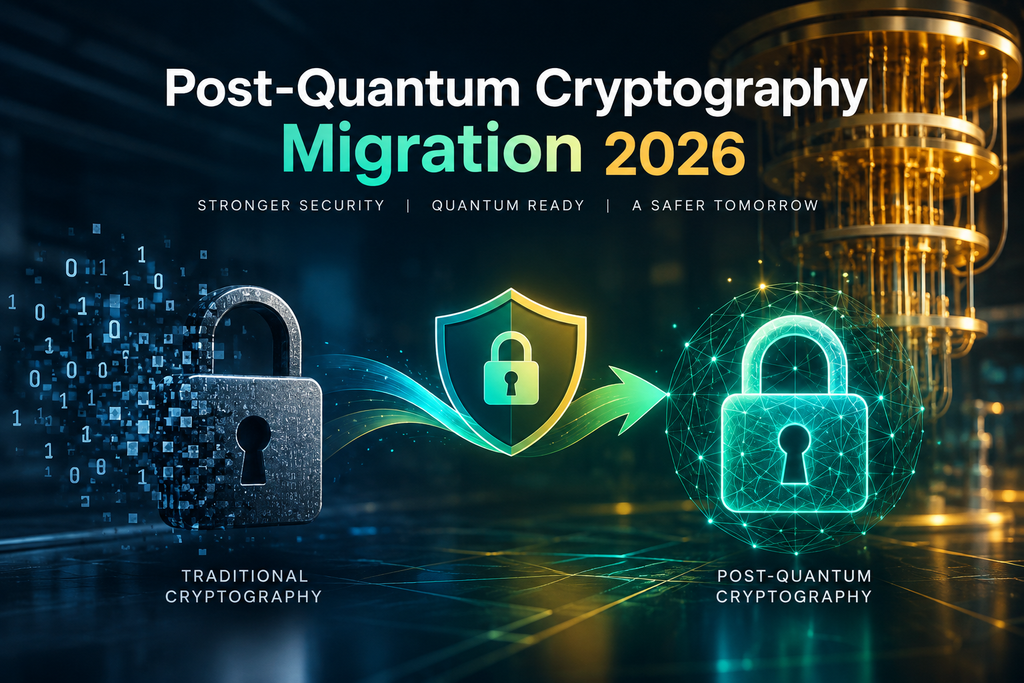
Post-quantum cryptography migration has moved from a research curiosity to a board-level mandate in 2026. The algorithms that protect nearly every login, payment, and signed document today — RSA and elliptic-curve cryptography — are mathematically breakable by a sufficiently powerful quantum computer. That computer does not exist yet. The data it will one day unlock is already being stolen.
This guide explains why post-quantum cryptography migration is urgent now, what the new NIST standards actually require, and how to build a rollout plan that survives contact with production systems. Every section below is built around the practical steps a real post-quantum cryptography migration program has to take.
Table of Contents
Why Post-Quantum Cryptography Migration Can’t Wait
The core threat is called “harvest now, decrypt later.” Adversaries are already archiving encrypted internet traffic today, betting that a future quantum computer will let them decrypt it years down the line. Delaying post-quantum cryptography migration doesn’t remove that risk — it just leaves more data exposed for longer. If your data needs to stay confidential for a decade or more — health records, trade secrets, national security material — it is already at risk, regardless of when a quantum computer actually arrives.
Three developments converged to make 2026 the year post-quantum cryptography migration became unavoidable:
- The standards are final. NIST finalised FIPS 203, 204, and 205 in August 2024, giving organisations vetted, production-ready algorithms for the first time.
- Governments made it mandatory. The NSA’s Commercial National Security Algorithm Suite 2.0 sets firm deadlines for national security systems, and a June 2026 executive order accelerated government-wide migration requirements.
- Deadlines are landing. NIST’s own FIPS 140-2 validation moved to historical status in September 2026, forcing agencies and vendors to certify against the newer, quantum-resistant standards.
The New Standards Behind Post-Quantum Cryptography Migration
Every post-quantum cryptography migration plan now centres on three finalised NIST standards:
| Standard | Purpose | Replaces |
|---|---|---|
| FIPS 203 (ML-KEM) | Key establishment | RSA / ECDH key exchange |
| FIPS 204 (ML-DSA) | Digital signatures | RSA / ECDSA signatures |
| FIPS 205 (SLH-DSA) | Hash-based signatures, high assurance | ECDSA in conservative use cases |
ML-KEM and ML-DSA rely on lattice-based mathematics, chosen because no efficient quantum algorithm is currently known to break them. SLH-DSA offers a more conservative, hash-based alternative for the highest-assurance signing use cases. A fifth algorithm, HQC, was selected in March 2025 as a structurally different backup in case a weakness is later found in lattice-based schemes. Any post-quantum cryptography migration plan should treat all three finalised standards as the technical baseline, with HQC held in reserve.
Where Enterprise Post-Quantum Cryptography Migration Actually Stands
The gap between awareness and action is enormous. A 2025 survey of over a thousand senior cybersecurity leaders found that 69% recognised quantum computing as a threat to their current encryption, yet only 5% had quantum-safe encryption actually deployed. A separate 2026 study put active transition efforts at roughly 40% — but that figure likely counts planning and assessment work, not completed deployment.
Progress is visible where it matters most: cryptographic visibility. By Q1 2026, roughly 38% of Fortune 500 firms had completed at least a partial cryptographic inventory, up from just 12% in late 2024. You cannot run a post-quantum cryptography migration on systems you cannot see, so this inventory step is where every credible program begins.
Major cloud and browser vendors are moving faster than most enterprises. Cloudflare, Google, and Microsoft have all updated their timelines in 2026 for becoming fully post-quantum secure, which means the infrastructure layer of post-quantum cryptography migration is increasingly ready even where individual companies are not.
A Five-Phase Post-Quantum Cryptography Migration Roadmap
Use this sequence to run post-quantum cryptography migration as a manageable program rather than a scramble. It mirrors what NIST’s own migration guidance and the enterprises furthest along are actually doing.
Phase 1: Build a cryptographic inventory
Discover every place cryptography is used — TLS certificates, code-signing keys, VPNs, embedded firmware, and static trust stores buried inside legacy applications. Passive network monitoring alone misses hard-coded keys; pair it with binary and SBOM scanning.
Phase 2: Score by data lifetime and exposure
Not everything needs the same urgency in a post-quantum cryptography migration. Rank systems by how long the data must stay confidential and how exposed it is to “harvest now, decrypt later” collection. Long-lived secrets move to the front of the queue.
Phase 3: Deploy hybrid cryptography first
Almost no serious post-quantum cryptography migration jumps straight to PQC-only systems. Hybrid schemes pair a classical algorithm (RSA or ECDSA) with a post-quantum one (ML-DSA), requiring both to validate. If a flaw is later found in either scheme, the connection still holds.
Phase 4: Validate against real infrastructure
Test performance, certificate size, and compatibility with existing hardware security modules before wide rollout. ML-KEM and ML-DSA produce larger keys and signatures than their classical counterparts, which can affect legacy systems with tight bandwidth or storage limits.
Phase 5: Phase out classical algorithms deliberately
Once hybrid deployments are validated, retire classical-only cryptography for new systems first, then migrate legacy systems on a scored schedule. Track post-quantum cryptography migration completion the same way you’d track a zero-trust rollout: with measurable milestones and named executive owners.
Building Crypto Agility Into the Program
The single most valuable outcome of a well-run post-quantum cryptography migration is not a specific algorithm — it’s the capability to swap algorithms again without a forklift upgrade. This is called crypto agility, and it matters because NIST itself has already flagged that today’s lattice-based standards could theoretically need replacement if a future mathematical breakthrough weakens them. Building crypto agility now makes any future post-quantum cryptography migration far cheaper.

Practical crypto agility means:
- Abstracting cryptographic calls behind a library layer, not hard-coding algorithm choices into applications.
- Choosing vendors and hardware security modules that already support multiple PQC algorithm families.
- Running periodic crypto-discovery scans as a standing process, not a one-time project.
Common Mistakes in Post-Quantum Cryptography Migration
Treating it as a pure IT project. The most successful post-quantum cryptography migration programs give ownership to a named executive outside the security team alone, with board-level visibility — the same shift that happened with zero-trust adoption a few years earlier.
Skipping the inventory step. Teams that deploy PQC algorithms before mapping their cryptographic footprint routinely miss embedded systems, third-party SDKs, and static trust stores — leaving the biggest risks in their post-quantum cryptography migration untouched.
Treating draft guidance as final policy. NIST IR 8547, which proposes 2030 and 2035 deprecation dates for classical algorithms, remains an Initial Public Draft. Use the finalised FIPS 203/204/205 as your technical baseline, and label anything from the draft as a proposed timeline, not a locked deadline.
Waiting for a “safe” vendor ecosystem. Enough HSM vendors, cloud providers, and certificate authorities already support ML-KEM and ML-DSA that waiting for full market maturity mostly just delays the inventory and hybrid-deployment work that has to happen regardless.
Will AI Replace Jobs in 2026? What Is Actually Changing

Few questions dominate boardrooms, dinner tables, and job-search forums right now quite like this one: will AI replace jobs in 2026? It’s not an abstract, futuristic worry anymore — it’s showing up in earnings calls, layoff announcements, and hiring freezes happening right now. Some headlines claim entire professions are disappearing overnight, while others insist AI is just another productivity tool, no different from the spreadsheet or the internet before it. The truth, as usual, sits somewhere in between, and it’s more specific — and more interesting — than either extreme.
This article breaks down what the actual 2026 data says about will AI replace jobs in 2026, which roles are genuinely shrinking, which are growing, and what’s changing beneath the surface that doesn’t always make the headlines.
Frequently Asked Questions
What is post-quantum cryptography migration? It is the process of replacing cryptographic algorithms vulnerable to quantum attacks — mainly RSA and elliptic-curve schemes — with NIST-standardised, quantum-resistant algorithms like ML-KEM and ML-DSA.
Why start post-quantum cryptography migration now if quantum computers don’t exist yet? Because of “harvest now, decrypt later” — adversaries can capture encrypted data today and decrypt it once a capable quantum computer exists, which puts any long-lived secret at risk right now.
Is post-quantum cryptography migration mandatory? For U.S. national security systems and federal agencies, yes, under CNSA 2.0 and recent executive orders. For the private sector, it isn’t yet legally required in most cases, but regulators and major vendors are moving fast enough that early movers avoid a costly scramble later.
How long does a full post-quantum cryptography migration take? Large enterprises typically plan multi-year programs, starting with a cryptographic inventory, moving to hybrid deployments, and completing full transition on a schedule tied to each system’s data-sensitivity and exposure.
What’s the difference between ML-KEM and ML-DSA? ML-KEM (FIPS 203) handles key establishment — the equivalent of today’s RSA or ECDH key exchange. ML-DSA (FIPS 204) handles digital signatures, replacing RSA and ECDSA signatures.
Do I need to replace all my cryptography at once? No. Nearly every real-world post-quantum cryptography migration uses hybrid cryptography first, running classical and post-quantum algorithms side by side before retiring the classical layer.
The Bottom Line
Post-quantum cryptography migration is no longer a future problem to plan for eventually. The standards are final, the government deadlines are real, and the data at risk is being collected today, not someday. Enterprises that start with a cryptographic inventory, deploy hybrid schemes first, and build genuine crypto agility will move through this transition on their own schedule. Everyone else will run their post-quantum cryptography migration during an incident instead of before one.
Ready to map your exposure? [Book a free cryptographic inventory assessment] and we’ll identify your highest-priority systems before your next audit cycle.
ON-PAGE CHECKLIST BEFORE YOU HIT PUBLISH
- [ ] Focus keyphrase in SEO title, slug, meta description, H1, first sentence, 4 H2s, one alt tag
- [ ] Only one H1 on the page
- [ ] Meta description under 156 characters with an action verb
- [ ] 3 outbound links to authority domains, 3+ internal links
- [ ] All images compressed to WebP, descriptive file names, unique alt text
- [ ] Article + FAQPage schema added
- [ ] Table of contents block enabled for the 9 H2s
- [ ] Mobile Core Web Vitals: LCP under 2.5s, CLS under 0.1
- [ ] Transition words in 30%+ of sentences (however, yet, so, because, once, instead)
- [ ] Paragraphs max 4 lines, sentences mostly under 20 words
- [ ] Publish date and “last updated” date visible for freshness signals
- [ ] Author bio with credentials for E-E-A-T
Outbound authority links (dofollow, open in new tab)
- NIST Post-Quantum Cryptography Standards —
https://pages.nhttps://pages.nist.gov/nccoe-migration-post-quantum-cryptography/FAQ/index.html\ - Cloud Security Alliance PQC Migration Roadmap —
https://labs.cloudsecurityalliance.org/research/strategic-post-quantum-cryptography-migration-enterprise-roa/ - NSA Commercial National Security Algorithm Suite 2.0 guidance